Research Background
China is experiencing a significant demographic shift towards an ageing population. This demographic change is becoming increasingly important for healthcare, social services and the design of accessible digital systems for older adults.
1、Who is considered an older person in China?
Under China’s Law of the People’s Republic of China on the Protection of the Rights and Interests of Older Persons, an older person is legally defined as a citizen aged 60 or above (National Health Commission, 2018).
This distinction is important because being an older person and being retired are not necessarily the same thing. A person aged 60 or above is legally considered an older person, while the statutory retirement age depends on employment category and is currently undergoing gradual reform.
2、China‘s aging population
According to the National Bureau of Statistics, at the end of 2025, China had a total population of 1.40489 billion.
People aged 60 and above numbered 323.38 million, accounting for 23.0% of the total population. Among them, 223.65 million people were aged 65 and above, representing 15.9% of the population (National Bureau of Statistics, 2026).
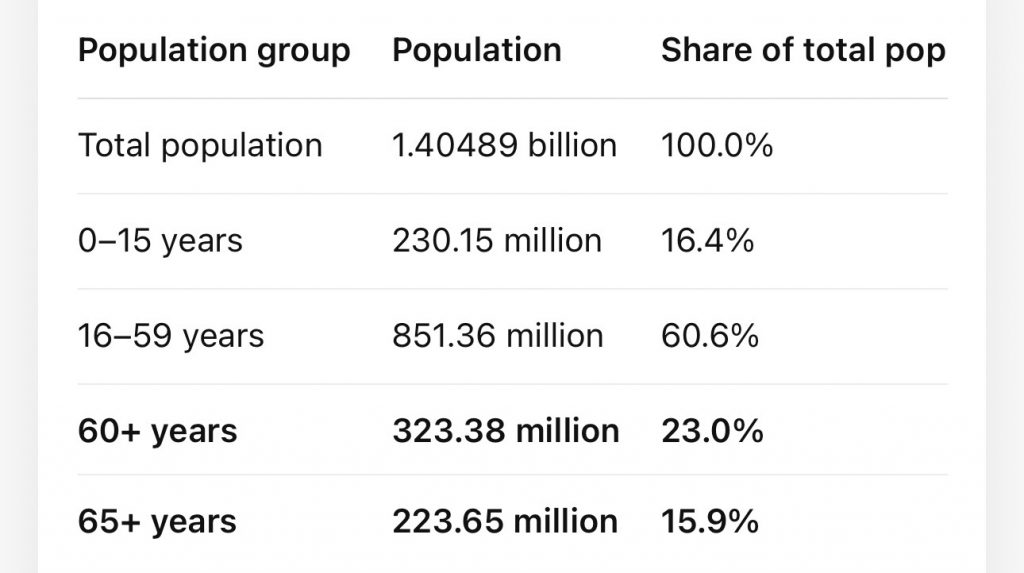
This means that approximately one in every four people in China is now aged 60 or above. The scale of the older population makes ageing an important issue not only for pensions and social care, but also for healthcare access and the design of public and digital services.
China is also experiencing population decline. In 2025, there were 7.92 million births and 11.31 million deaths, resulting in a natural population growth rate of -2.41% (National Bureau of Statistics, 2026).
3、 Life expectancy
China’s life expectancy has continued to increase. According to the National Bureau of Statistics, average life expectancy at birth reached 79.25 years in 2025 (National Bureau of Statistics, 2026).
The increase in life expectancy means that people are potentially spending a longer period of their lives in older age. Combined with the growing number of people aged 60 and above, this creates increasing demand for healthcare, chronic disease management, preventive care and accessible healthcare services.
4、Retirement age in China
China is currently undergoing a major reform of its statutory retirement system.
From 1 January 2025, China began a 15-year gradual increase in the statutory retirement age. The reform will eventually increase the statutory retirement age:
- Men: from 60 to 63
- Women previously subject to a 55-year retirement age: from 55 to 58
- Women previously subject to a 50-year retirement age: from 50 to 55
The change is gradual rather than immediate. For example, from 2025, the retirement age for male employees and women previously subject to a 55-year retirement age increases by one month every four months, while the retirement age for women previously subject to a 50-year retirement age increases by one month every two months (National People’s Congress, 2024).
The reform also introduces greater flexibility. Eligible workers may voluntarily choose early retirement within the permitted limits, while retirement can also be postponed by up to three years when the relevant conditions and agreement with the employer are met (National People’s Congress, 2024; Ministry of Human Resources and Social Security, 2025).
5、 Why this matters for healthcare and digital inclusion?
These demographic changes provide an important context for research into older adults and healthcare in China.
China now has more than 320 million people aged 60 and above, while life expectancy has reached 79.25 years. At the same time, the country is experiencing population decline and reforming its retirement system.
This suggests that healthcare systems will increasingly need to support a large and growing older population over a longer period of later life.
For research concerning older adults, healthcare access and digital technology, the distinction between age, retirement and health status is particularly important. Not every person aged 60 or above is retired, and older adults are not a homogeneous group. Differences in age, health, digital literacy and independence may significantly affect how people access healthcare services.
Therefore, for this research, 60 years and above is used as the primary definition of “older adults”, based on the legal definition in China, while the 65+ population can be used as an additional demographic indicator.
Key Statistics
- 60+ population: 323.38 million
- Share of population aged 60+: 23.0%
- 65+ population: 223.65 million
- Share of population aged 65+: 15.9%
- Total population: 1.40489 billion
- Life expectancy at birth: 79.25 years
- 2025 births: 7.92 million
- 2025 deaths: 11.31 million
- Natural population growth rate: -2.41‰
- Legal definition of older person: 60 years and above
- Retirement reform began: 1 January 2025
- Final statutory retirement ages: 63 for men; 58 or 55 for women depending on the original retirement category
The data indicate that population ageing in China is not a small or temporary demographic issue. With more than 320 million people aged 60 and above and an increasingly long life expectancy, the accessibility of healthcare services for older adults is becoming an increasingly important social and design challenge.
In particular, as healthcare services become increasingly digitalised, accessibility should not be considered only in terms of whether older people can use technology. It should also consider whether healthcare systems are designed around the different abilities, needs and circumstances of an aging population.
References
National Bureau of Statistics of China (2026) ‘Statistical Communiqué of the People’s Republic of China on the 2025 National Economic and Social Development’. Available at: https://www.stats.gov.cn/xxgk/sjfb/tjgb2020/202602/t20260228_1962662.html (Accessed: 19 August 2026).
National Health Commission of the People’s Republic of China (2018) ‘Law of the People’s Republic of China on the Protection of the Rights and Interests of Older Persons’. Available at: https://www.nhc.gov.cn/zwgk/fagui/201307/6de2e73ecd1b4cdb8530c468d431cfba.shtml (Accessed: 19 August 2026).
National People’s Congress of the People’s Republic of China (2024) ‘Decision on Implementing Gradual Delayed Statutory Retirement Age’. Available at: https://www.npc.gov.cn/npc/c2/kgfb/202409/t20240913_439534.html (Accessed: 19 August 2026).
Ministry of Human Resources and Social Security of the People’s Republic of China (2025) ‘Interim Measures for Implementing a Flexible Retirement System’. Available at: https://www.mohrss.gov.cn/ (Accessed: 19 August 2026).
Leave a Reply