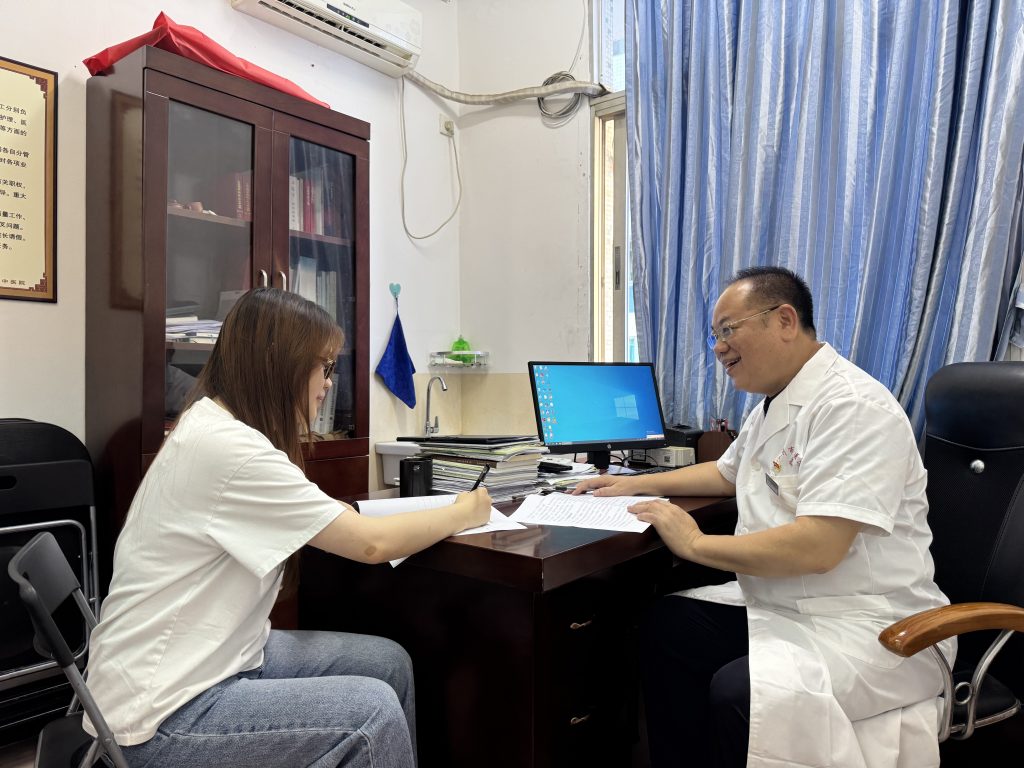
interview with Dr.Wenbo Zhou of Traditional Chinese Medicine Hospital in Zhangzhou City, Fujian Province
Interview with a Hospital Vice President Dr.Zhou: Rethinking Healthcare Accessibility for Older People
As part of my research into older people and healthcare accessibility, I conducted a short interview with a hospital vice president to understand the difficulties older patients experience when seeking medical care, as well as how hospitals are currently trying to address these challenges.
The interview made me realise that healthcare accessibility for older people is not simply a matter of whether they can use a smartphone or a healthcare app. It is a more complex issue involving digital technology, healthcare services, hospital management and the allocation of resources.
What I Learned from the Interview
The vice president first discussed a contradiction created by the digitalisation of modern society.
Digital technology has made our everyday lives increasingly convenient and has improved the efficiency of how society operates. However, these systems are often designed around the abilities and speed of the majority of users.
For older people, limitations in mobility, information processing, educational background and digital skills can make some services difficult to access. Therefore, a digital system that is convenient and efficient for younger people may actually become a barrier for some older users.
This made me start thinking:
Does a more efficient system necessarily mean that it is more convenient for everyone?
Perhaps not.
Older People May Need More Than a Simpler App
One point from the interview that particularly interested me was that the hospital is already trying to address this issue.
Dr.zhou explained that the hospital currently provides telephone appointment services. If an older person does not know how to use an online booking system but knows that they need to see a doctor, they can call the hospital directly and receive assistance from staff with making an appointment.
From the perspective of an older patient, this is a very direct solution.
They do not need to learn complicated procedures or navigate through a website, find the correct department, select a doctor and confirm a time. Instead, they can simply use something familiar to them: making a phone call.
However, this solution also creates a practical challenge.
Telephone appointments require staff to answer calls, check doctors’ schedules, confirm appointment times and complete the booking process manually. If a large number of older patients rely on this service, the hospital needs to invest more staff time and therefore face higher labour costs.
This revealed an important tension to me:
More personalised and human-centred services often require more human resources, while highly efficient digital services can potentially exclude some older people.
Why Are Appointments More Than Just a Convenience?
The interview also changed the way I understand hospital appointment systems.
Previously, I thought appointments were mainly about making healthcare more convenient for patients. However, from the perspective of hospital management, appointments are also an important way of managing resources.
For patients, appointments provide:
- The ability to choose their preferred doctor;
- A clear understanding of when they need to arrive;
- Better control over their time;
- Less uncertainty and waiting.
For hospitals and doctors, appointments allow them to:
- Estimate the number of patients in advance;
- Organise doctors’ working time more effectively;
- Manage consultation time;
- Maintain the quality of healthcare services.
The vice president emphasised an important point:
Healthcare should not simply aim to see more patients. Quality should come before quantity.
If a doctor has to see too many patients within a limited amount of time, each patient may receive less attention, which can affect communication, diagnosis and the overall healthcare experience.
This may be particularly important for older patients.
They may need more time to explain their symptoms, understand medical information or confirm what they need to do next.
Therefore, if a system focuses only on speed and quantity, it may actually make healthcare more difficult for some older patients.
The Problem Is More Complex from the Hospital’s Perspective
The interview also helped me understand that improving healthcare access for older people cannot simply be solved by “adding more services”.
Hospitals themselves have limitations in terms of resources and costs.
For example, providing a dedicated telephone appointment service requires staff to answer calls, check doctors’ availability, confirm appointment times and operate the hospital’s booking system.
This means:
More human support = Higher labour costs.
Therefore, the ideal solution cannot simply be:
“We should provide more human assistance for older people.”
Instead, we need to think further:
How can we provide older people with accessible ways of entering the healthcare system without creating unsustainable additional costs?
This is one of the most valuable insights I gained from the interview.
My Reflection
Before this interview, I mainly understood the problem through the concept of the digital divide.
My thinking was relatively simple:
Older people struggle to use digital healthcare platforms → therefore, they have difficulty accessing healthcare services.
However, this interview made me realise that the problem is much more complex.
I now see it more as an issue of service inclusion.
Instead of only asking:
“How can we teach older people to use digital technology?”
We should also ask:
“Can healthcare systems provide different ways for people with different abilities to access the same service?”
Some people may prefer using an app. Others may feel more comfortable making a phone call, while some may need face-to-face assistance.
These approaches do not necessarily need to replace one another. They can function as different entry points into the same healthcare system.
A Small Conclusion
This interview shifted my thinking from digital exclusion towards the design of the service system itself.
The difficulty older people experience may not simply be because they are “not good with technology”. Instead, many modern services are designed around an ideal user: someone who can read quickly, understand information, use a smartphone, complete online processes and make decisions independently.
But real users are much more diverse.
Some people need more time. Some need human assistance. Some feel more comfortable communicating by telephone.
Therefore, truly inclusive healthcare does not necessarily mean creating a completely separate system for older people. Instead, online services, telephone services and human support could work together as complementary pathways.
This also gives me a new direction for my intervention.
Rather than designing another healthcare app, I want to explore how different service channels can work together, allowing older people to access healthcare in a way that is familiar, understandable and manageable for them.
The most important insight I took from this interview is:
We should not only ask older people to adapt to the healthcare system. We should also ask how the healthcare system can adapt to different users.
Leave a Reply